Dove Ellis - Blizzard
As 2025 gave way to 2026, many of us welcomed the new year with a sense of relief. For Thomas O’Donoghue, however, the closing months of the year were marked by a dramatic shift. Under the moniker of Dove Ellis, he released his debut album, Blizzard, and found himself moving from relative obscurity into sharp focus.
Dropping at the beginning of December, the record was met with widespread critical acclaim. Just weeks earlier, he had also been playing some of his biggest shows to date, supporting Geese on their hotly anticipated US tour, a run that brought his music to the attention of a much wider audience. “I got booked on the Geese tour in late May or early June,” he tells me. “I knew that when it came around, there were going to be so many more eyes on me.”
We speak over video call just a few days into 2026. O’Donoghue is back at his childhood home, dressed simply in a black hoodie, his blonde hair characteristically unkempt. The setting feels far removed from the expectant gaze of his rapidly growing fan base and the accompanying online discourse.
In the weeks following Blizzard’s release, coverage has been quick to draw lofty comparisons. Reviewers have floated names such as Jeff Buckley and Thom Yorke, eager to position O’Donoghue as the latest in a long line of enigmatic, emotionally charged frontmen. He, however, seems unconvinced by the narrative forming around him. “It’s cool, but it’s also very bizarre,” he says. “I feel very separate from it, and because of that it’s kind of funny.”
Spending the festive period at home has offered a brief reprieve from the rapid acceleration. Still, he senses a change. “I see my own artistic self as very different to how my artistic self comes across publicly right now,” he observes. The question, then, becomes less about the mutating mythology surrounding Dove Ellis and more about how O’Donoghue understands his own work.
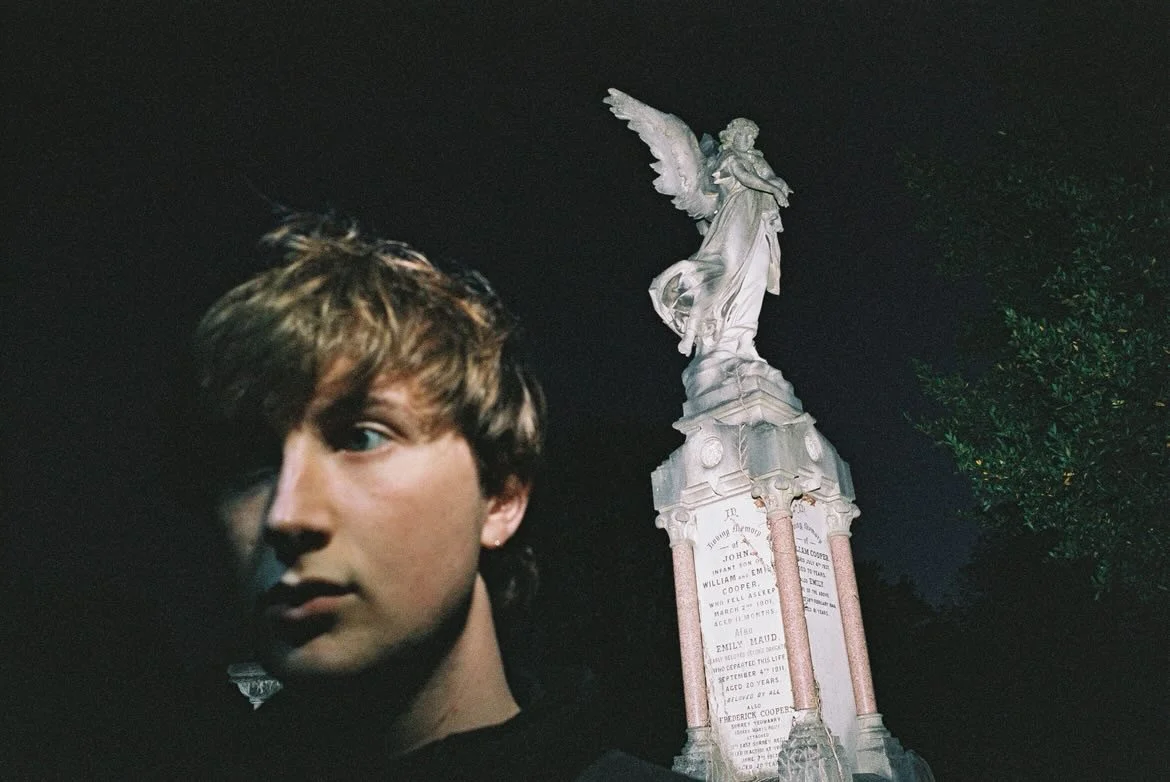
Photo Credit: Dove Ellis by Jamie Salmons
Raised in Galway, music was always a constant presence. His mother encouraged him to learn piano at a young age, though it failed to truly grab his attention. “I never really clicked with that,” he says. “But when I picked up the guitar, that was the catalyst to start writing.” He began putting pen to paper, crafting songs at just thirteen years old. Though he describes himself as “less literarily inclined” at the time, the foundations of his musical DNA were slowly being laid.
“One of the longest musical influences I’ve had in my life is probably Prince,” he recalls. “In some respects, I think I had an unhealthy relationship with him when I was a kid. I really liked that he did a load of music on his own. I really liked how self-reliant he was. I idealised his process quite a bit.”
At first glance, Prince may seem like an unlikely reference point for Blizzard, an album rooted in brooding introspection and minimalist, economical song structures. Yet, the connection becomes clearer in the record’s layered textures, looping motifs and careful attention to form. “He’s the artist I go back to for inspiration,” O’Donoghue says. “Even in the studio, just putting on ‘Take Me With You’ can be a good reset.”
For much of his early life, music-making was a solitary pursuit. Aside from a brief stint in a band as a teenager, he spent most of his time writing and recording alone, teaching himself how to shape songs and capture the essence of feeling. However, this was a process often marked by frustration.
“That didn’t really change until I moved to Manchester,” he explains. “That’s when I stopped being so insulated. I was forced to make music in the wider world, but I was shit,” he laughs. “I was immature and had no real sense of my own voice.”
Playing informally with friends over the next few years, predominantly in a live setting, helped to sharpen his instincts. What remained elusive however, was studio experience, and in turn, the chance to give his songs a sense of permanence.
His first proper recording would eventually come in 2022 when he released a track independently, before quietly removing it just months later. “I stopped liking it,” he says, displaying a creative restlessness that has never quite gone away. “I have a bad compulsion to want to change things all the time,” he admits, a tendency that partly explains why Blizzard was released only a few months after it was recorded.
Momentum began to build more seriously for him once he started performing more regularly in London and met his current manager. “I got more people offering me studio time, and I got more practice.”
By late 2024, a clearer sense of direction had emerged. “We recorded ‘To The Sandals’ in October, in a studio in Liverpool with an engineer called Sophie Ellis,” he explains. “That was the first song where I realised what I was going to do for an album. It felt like a breakthrough.” The track unfolds gradually, its warm, crudely plucked acoustic guitar lines giving ample space for his voice to flood the recording in moments of soaring euphoria.
‘Love Is’ was also recorded during those sessions. The remaining tracks however, were completed in London the following September, alongside Dani Bennett Spragg and a rotating cast of collaborators. “We had different people in and out of the studio at various times,” O’Donoghue remembers, “but the most consistent two for the whole process were Fred and Matt, who I did the Geese tour with.”
While Dove Ellis began as a largely solitary project, Blizzard reflects a growing comfort with collaboration, even as O’Donoghue keeps a keen eye on the details. At its centre however, sits that voice. Elastic, controlled and unusually assured for a debut record, it carries lyrics that often feel exposed, intimate and spiritually unresolved. In that sense, the comparisons with Buckley feel apt, but are by no means definitive.
“Before I got any good at recording, most of what I was trying to do with songwriting was about finding something I thought had some kind of value,” he says, before quickly checking himself. “Maybe value is the wrong word, but a degree of truth. I used to be a lot more preoccupied with that.”
That concern runs throughout the record. The writing has a quiet, contemplative quality, allowing moments of emotional clarity to surface alongside the swell of accompanying instrumentation, a sensation that becomes more pronounced over multiple listens.
His admiration for Shane MacGowan seems particularly revealing in that sense. “I never felt like Shane was trying to say something, or aiming at a point,” he says. “There was an easiness to it. That’s something I really loved and something I’m always trying to reach, even if I can’t do it like him.”
Writing, he explains, is a discipline as much as pure inspiration. He describes oscillating between moments that feel almost involuntary and others that are more hard-fought. “There are verses or choruses or lines where it really feels like it wasn’t me that wrote it,” he explains. “At the same time, the next verse will be unbelievably me, full of very clear decisions and stuff like that.”
He is also acutely aware of how unreliable those moments of divine intervention can be. “You get these very enthralling bursts,” he says. “But they’re unpredictable. I don’t want to depend on those ‘visits’. Even when I’m waiting for the next one, I’m still putting things down.”
For all the attention Blizzard has attracted, O’Donoghue clearly remains focused on the work itself. Sitting at home, removed from the noise surrounding his debut, it’s clear this album represents a beginning rather than a culmination, just one step along a path still being worked out. The headlines may have seemingly come from nowhere, but his priorities remain unchanged amongst the noise. Keep writing, keep recording and continue honing the craft, even in those moments when the sense of magic proves elusive. One album down, this is where the story of Dove Ellis really begins.
Blizzard by Dove Ellis is out now.