Group A.D. - Colour Space Transform

Last week, Group A.D. announced their debut EP Colour Space Transform. The project’s title track was premiered by Lauren Laverne on BBC 6Music and has since received widespread coverage and acclaim.
Emerging from Leeds’ evergreen alternative scene, the seven-piece have quickly made a name for themselves as a formidable creative presence within the city. Their new material, however, suggests that recognition will soon stretch far beyond the encircling A roads.
We caught the band at one of their first live outings late last year, supporting Mercury Prize winners and regional relatives English Teacher at the O2 Academy. Their set was an uproarious collision of groove, rhythm and silver-screen textures. A psychedelic, no-wave sprawl that held the sold-out crowd in the palm of their hands from start to finish.
At a moment when culture feels as though it’s edging back from an over-engineered precipice, Group A.D.’s arrival feels timely. There’s a growing pull towards music that feels human — something made by people thrashing out ideas in a room together — with the runaway success of Geese perhaps offering the clearest indication of this growing demand.
With artists like Sven Wunder also helping to further renew interest in more referential, orchestral arrangements, Group A.D. manage to build on that lineage while pushing their sound somewhere more jagged and earthy — music that pulls you back into the body from our collective, cerebral stupor. We recently caught up with Aidan from the band to talk about their influences, process and what they’re all about.
Who or what is Group A.D.?
Group A.D. is a new music project from Leeds. There are seven of us, and we play a range of instruments - samplers, violins, drums, synthesisers, guitars, percussion and effects. Our music lies somewhere between spaghetti western soundtracks, no-wave, post punk and punk-funk.
Where did the name come from, and how does it guide your work?
The name is an initialism for the Group For Action & Dance, two cornerstones on which the music is based. Stylistically, I liked the guerrilla feel of Group A.D.- utilitarian and cold, but also the openness and warmth of the Group For Action & Dance - represents a communal aspect, shared between seven people.
When you first started, were there any shared ideas or instincts that felt important to get right?
When Group A.D. started, it was just me writing parts at home. Initially, there was a simple premise of making music defined by groove and rhythm, and that was important to establish. The first track released was ‘Theme For Group A.D.’, that acts as a primer for aspects of the Group A.D. sound - a definitive groove, widescreen orchestral moments and an apparent, but not defining electronic element. The music has always aimed to suggest at our eclecticism rather than imitate other genres.
You’ve announced Colour Space Transform as your debut EP, with the title track leading the way, how did that song come together?
Interestingly, ‘Colour Space Transform’ was actually the last song to be written for the EP, and it’s the track the best represents all elements of our sound. When writing the song, I started with a sample of an old French soul track. The string part was written around that, and then I removed the sample - the act of taking it away seemed to give the strings a yearning, cinematic feel - a waxing and waning which became the core of ‘Colour Space Transform’. It felt right to bring that string refrain into full bloom at the end of the song - like the closing credits of some strange television film.
With this single, you’ve talked about “looking back… to see ahead.” How does that idea relate to the EP as a whole?
‘Looking back…to see ahead’ is a quote from Daphne Oram - a brilliant early electronic composer who in many ways is responsible for the way in which we listen to, and create electronic music today. It’s in the spirit of experimentation and exploration that her words resonate. A lot of that is reflected in choosing specifically twentieth century stylings as musical touch-stones, whether that be specific choices of instrument - the bass VI for example, or production choices - the On-U Sound style has been a big influence too. Across the EP, we try to take a trip through portals into different eras.
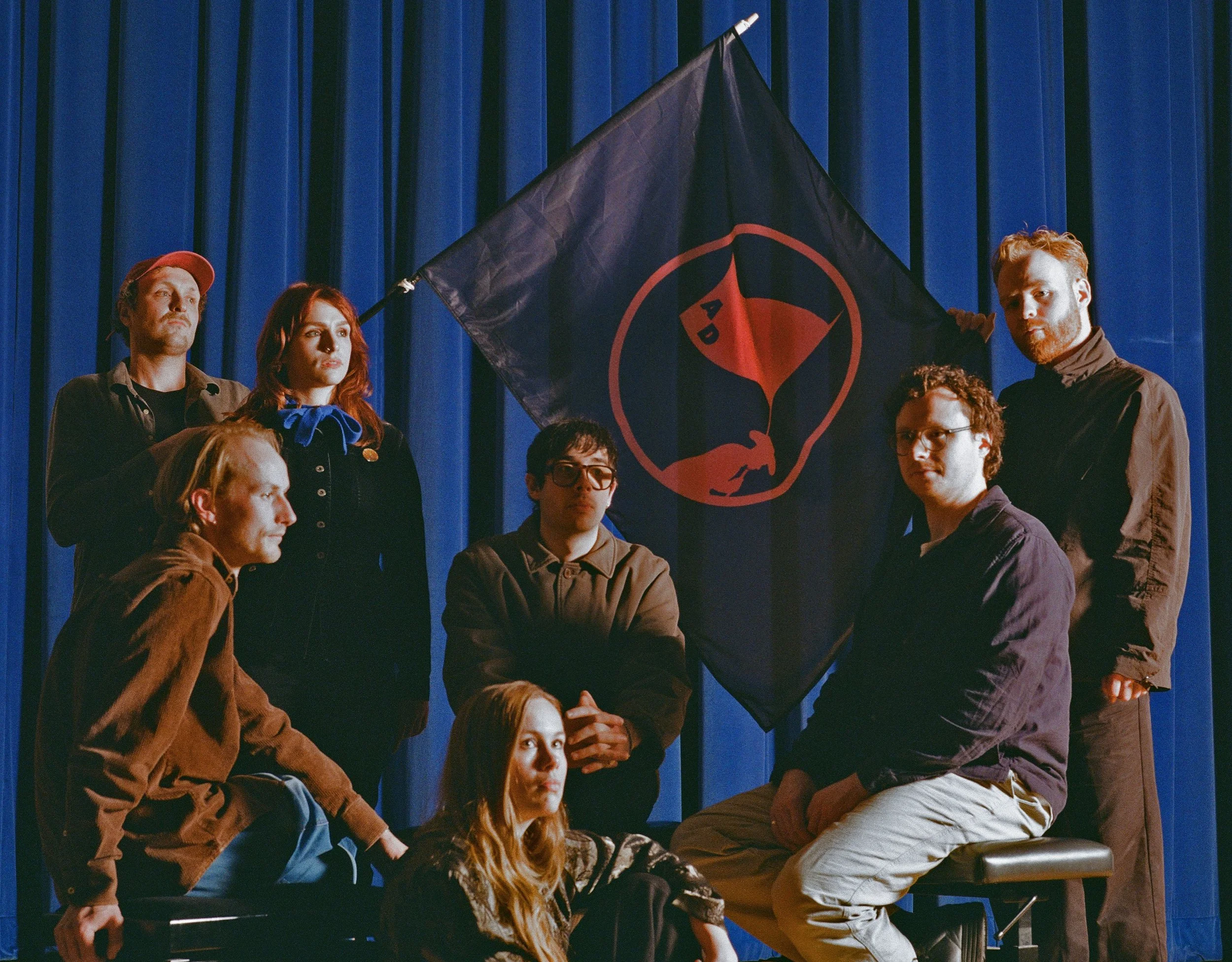
Photo credit: Group A.D. by Lucie Armstrong
Those different eras really do drift through the heart of your music, what keeps pulling you back to some of those older sounds?
Undoubtedly there is a huge cinematic string element to the sound, indebted to sixties film soundtracks, exotica and lounge music, and the work of John Barry in particular. Through years of working in a record shop, my musical tastes have expanded hugely - and I am very grateful for that. Maybe the EP is an attempt to make sense of that experience in some way.
Were there any records that felt especially important while this project was coming together?
Jet Harris and Tony Meehan’s ‘The Man From Nowhere’ in particular, a highly underrated track. Grace Jones’ ‘Slave To The Rhythm’, Nasmak’s ‘4our Clicks’ contain some excellent bass lines. Savant’s ‘Artificial Dance’, Material & William Burroughs’ ‘Seven Souls’. Loads.
What things outside of music have also poured into the EP?
Certainly films to a degree, though I am no dedicated cinephile. It’s more the idea of the music being written to accompany an imaginary scene - I’d like to think that the songs can conjure imagery when they are received, because they are certainly created in with a visual form in mind - that could be Brocken spectres in the case of the title track for example.
You’ve started playing live now, how did it feel to finally put the music in front of an audience?
It feels great and we can’t wait to play more. Our gigs have been busy and well received so far, but we have only played a handful of shows, so there is lots to learn. A Group A.D. gig feels like a special event - the nature of the music being so maximal means we have a lot of equipment as well as seven people on stage, so we will continue to try to provide a spectacle for the audience with our visuals, and our set up.
What do you hope people feel when they spend time with the EP?
We hope people enjoy it of course! I hope listeners can find something new, something familiar, something that they can’t quite put their finger on.
You’re another exciting act to come out of Leeds, what do you think makes the city such a fertile place for bands to learn their trade?
There are a myriad of reasons really. Historically, there has been an availability of rehearsal spaces for artists to learn their trade, however those spaces are rapidly diminishing in favour of corporate profit. This must be stopped. Undoubtedly, the Brudenell Social Club has a huge influence on the local scene, hosting all dayers, DIY gigs and local showcases, often on the same day as internationally recognised touring bands. It really is a great space for music and Leeds is very lucky to have it.
In Leeds, there is a tradition of not just being consumers of music, but showing a desire to get involved and do it yourself. Right from the art school post punk bands of the eighties, up to a thriving punk and hardcore scene today - there is a communal spirit to Leeds which is great. Though Leeds is of course a major UK city, it is also small enough to foster these kinds of scenes.
If you had to describe your sound in one sentence, what would you say?
‘This is the sound of the birds and the bees - because we are the Group for Action, and the Group for Dance, and this is the sound.’
Colour Space Transform is out March 27th.